

Table of Contents
- Why Standard Sizing Fails Real Bodies
- How to Measure Bra Size at Home: A 3-Minute Method
- Lingerie Styling Tips for Different Body Shapes
- Comfort First: Fabrics and Features That Work Daily
- How to Stop Shapewear Rolling Down
- Building Your Everyday Lingerie Wardrobe
- Your Body Changes: Adjusting Lingerie for Every Stage
- Conclusion: Wear What Makes You Feel Like You
- Frequently Asked Questions
Last Updated: September 8, 2026
Finding lingerie for everyday body types often feels like a guessing game where the house always wins. The sizing charts contradict each other, the styles assume a uniformity that real bodies simply do not have, and the result is a drawer full of unworn pieces that looked promising on the hanger. This guide from Saratily cuts through the noise to focus on the actual variables that determine whether intimate apparel works for you: accurate measurement, honest fit, and fabrics that respect your skin.
The core problem is that most fit advice is built around aesthetics rather than anatomy. When we talk about lingerie for everyday body types, we are really talking about engineering for movement, support, and comfort across a spectrum of silhouettes. Below, we will walk through a precise measuring method, styling strategies for various frames, and how to build a wardrobe that survives contact with real life.
Why Standard Sizing Fails Real Bodies
The fashion industry relies on vanity sizing and inconsistent grade rules, which means a size medium from one brand can fit entirely differently than a size medium from another. This inconsistency is not a personal failure; it is a systemic one. Mass-produced garments are drafted on fit models that represent a narrow ideal, leaving many customers to adapt themselves to the clothing rather than the reverse.
A practical consequence is that you cannot rely on the tag alone. The solution is to treat the tag as a starting point and prioritize the actual measurements of the garment. When shopping online, check the specific size chart for each item, because the same brand often uses different charts for different fabric compositions and cuts. This is the first step toward finding lingerie for everyday body types that actually aligns with your frame.
How to Measure Bra Size at Home: A 3-Minute Method
Measuring yourself accurately is the single highest-impact action you can take, yet most people are wearing the wrong band size because they were never taught how to measure bra size at home correctly. The process requires only a soft measuring tape and takes less time than brewing coffee.
- Measure your band: Wrap the tape snugly around your ribcage, directly under your bust. Keep it level and exhale normally. Record this number in inches, rounding to the nearest whole number.
- Measure your bust: Wrap the tape around the fullest part of your chest, keeping it parallel to the floor. Do not pull tight; allow the tape to rest against your skin. Round to the nearest whole number.
- Calculate your band size: This is where the traditional advice often fails. The old rule of adding four or five inches to your underbust measurement was designed for a time when bras had less stretch and different construction (PubMed). Most modern bras, especially those with multiple hook-and-eye closures, are designed to fit snugly on the loosest hook. A more reliable starting point is to use your underbust measurement directly as your band size. If your underbust measures 34 inches, start with a 34 band. If you are between sizes, or the band feels too tight on the loosest hook, try the sister size up (one band size up, one cup size down).
- Calculate your cup size: Subtract your band size from your bust measurement. Each inch of difference equals one cup size (1 inch = A, 2 inches = B, 3 inches = C, and so on). This is a starting point, not a final verdict. Cup volume is not static; a 34C holds the same volume as a 32D (its sister size). This means your cup size must change proportionally when your band size changes.
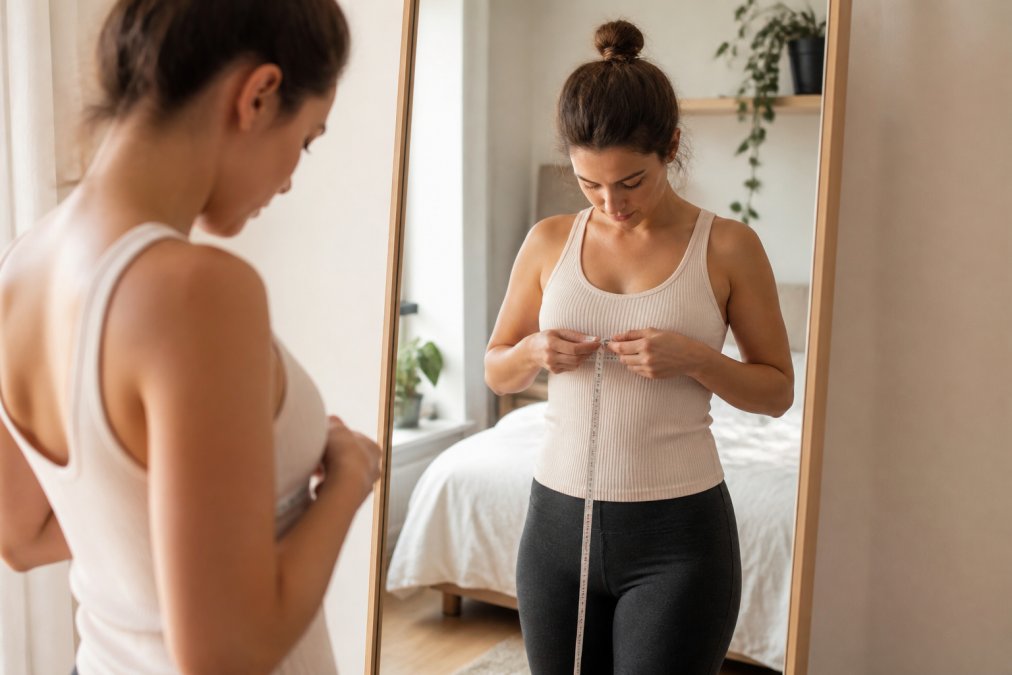
The tape measure gives you a baseline, but the true test is how the garment behaves on your body. The band should sit level across your back and stay put when you raise your arms. If the band rides up, it is too loose, regardless of what the tape said. If the center gore (the piece between the cups) does not lie flat against your sternum, the cups are likely too small or the band is too large. The underwire, if present, should encircle your breast tissue, not rest on it. A common pattern is that people with a larger cup size and smaller ribcage find that a band size down and a cup size up (the sister size) provides a more secure and supportive fit, as it accounts for the fact that cup volume scales with band length.
A practical check for band tension: you should be able to slide two fingers comfortably under the band at your back, but not a full hand. If you can pull the band more than two inches away from your body, it is too loose. Also, consider your torso length. People with a shorter torso often find that a longline bra or a bra with a wider side panel digs in at the waist, while those with a longer torso may need a bra with a higher underarm side panel for adequate support. Re-measure every six months or after any significant weight change of more than five to seven pounds, as ribcage and breast tissue density shift over time, independent of overall weight (peer-reviewed research).
Lingerie Styling Tips for Different Body Shapes
Styling is less about hiding perceived flaws and more about proportion and preference. The goal is to find cuts that complement your natural waistline and bust-to-hip ratio so the garment works with your movement, not against it. These lingerie styling tips for different body shapes prioritize structural support and visual balance over rigid rules.
Hourglass and Pear Shapes
For hourglass figures, where the bust and hips are balanced with a defined waist, high-waisted panties and corsets emphasize the natural waistline beautifully. A waspie or a high-leg brief accentuates the curve without adding bulk. For pear-shaped bodies, where the hips are wider than the bust, the strategy is to draw the eye upward. Look for bralettes with embellishment or lace detail at the neckline, and pair them with solid, seamless bottoms that provide coverage without digging in.
Athletic, Apple, and Petite Frames
Athletic and rectangle frames, characterized by a straighter silhouette, benefit from padded or push-up styles that add volume and create the illusion of a waist. Underwire or contour cups can help define the bust. For apple-shaped bodies, where weight gathers around the midsection, high-waisted briefs and shaping panties offer gentle support and a smooth line under clothing. Petite frames often find that balconette bras and vertical seams create lift without overwhelming the torso, while adjustable straps are essential for getting the correct fit.
Comfort First: Fabrics and Features That Work Daily
The difference between a piece you wear once and a piece you reach for weekly comes down to fabric hand-feel and construction. Lace and satin are beautiful, but they need to be lined or backed with soft cotton or modal to prevent irritation. A common mistake is prioritizing aesthetics exclusively, which leads to sensory overload and abandoned garments. This is especially true for the millions of people with sensory sensitivities, including those with autism, ADHD, or simply reactive skin, for whom a single scratchy seam or a stiff lace trim can make a garment unwearable (the WHO).
For daily wear, prioritize breathable materials and wireless construction. Many are turning to wire-free lift designs that provide support through engineered seams and fabric tension rather than rigid metal, which is a relief for those with sensory sensitivities. The Saratily™ Comfort Lift Bra is a strong example of this category, offering shaping and a floral lace back that feels as refined as it looks while remaining lightweight enough for all-day wear. But the category goes beyond a single product. Look for these specific features when evaluating a bra for sensory comfort:

- Fabric composition: Check the fiber content before you buy. A garment with at least 80% natural or breathable fibers like cotton, modal, or bamboo will be significantly more comfortable for extended wear than one made entirely from synthetic nylon or polyester, which trap heat and moisture. Modal, in particular, is a semi-synthetic fiber made from beechwood pulp; it is softer than cotton, drapes well, and is highly breathable, making it an excellent choice for sensitive skin. Bamboo viscose is another option, though its environmental credentials vary by manufacturing process.
- Seam placement and construction: Flatlock seams or seams that are taped or covered with a soft binding prevent chafing. Avoid bras with raised or bulky seams that sit directly over the nipple or along the underarm. Look for 'seam-free' or 'molded' cups that have no internal seams at all.
- Closure and adjustment points: For those with fine motor skill challenges or tactile defensiveness, front-closure bras or those with a simple pull-over design (often called 'bralettes' or 'sleep bras') eliminate the need to fiddle with multiple hook-and-eye rows. If you need adjustability, look for wide, padded straps that distribute pressure evenly rather than thin straps that dig into the shoulder.
- Tagless construction: A seemingly minor detail, but a woven tag at the neckline or underarm is a common source of irritation. Many comfort-focused brands now print care instructions directly onto the fabric, eliminating the tag entirely.
How to Stop Shapewear Rolling Down
Shapewear rolling down is the most common complaint, and it usually stems from a mismatch between the garment's compression level and your torso length. The garment rolls because it is either too tight at the waist or too short to anchor itself against your natural curves.
The fix is twofold. First, choose the correct size; compression that is too aggressive will always migrate. Second, look for styles with silicone grippers or a higher back rise. A high-waist shaping panty that extends past your natural waistline has more surface area to grip, reducing the likelihood of rolling. When putting it on, roll it up your legs like a stocking rather than pulling it over your hips, which allows the fabric to sit evenly and prevents twisting.

Building Your Everyday Lingerie Wardrobe
A functional wardrobe is built on versatility. Instead of buying matching sets that you only wear for special occasions, invest in separates that can be mixed and matched. The foundation should include two neutral bras in your correct size, one seamless option for fitted tops, and at least two high-waisted panties that provide coverage and comfort.
Budget-friendly pieces are fine for trend-driven items, but investment is justified for daily basics where construction quality directly impacts longevity. A well-constructed bra lasts significantly longer than a fast-fashion alternative because the elastic and stitching hold up to repeated washing. The Saratily collection offers a range of shaping panties, from the High-Waist Butt Lifter to the Ice Silk Butt Lift version, which use different fabric technologies to address varying levels of desired compression and breathability.

| Wardrobe Staple | Best For | Key Feature to Look For |
|---|---|---|
| Wire-free bra | Daily comfort and sensory sensitivities | Soft, breathable fabric with seam-based support |
| High-waist shaping panty | Smoothing under fitted clothing | Silicone grips or high back rise to prevent rolling |
| Seamless brief | Everyday wear under thin fabrics | No visible lines, moisture-wicking material |
| Lace bralette | Low-cut tops and relaxed styling | Lined cups to prevent irritation |
Your Body Changes: Adjusting Lingerie for Every Stage
Bodies are not static. Weight fluctuations, pregnancy, postpartum changes, and hormonal shifts alter your bust size and waistline, sometimes dramatically. The lingerie that fit you six months ago may no longer provide adequate support, and that is normal. Re-measuring every six months is the most reliable way to ensure you are wearing the correct size.
Postpartum bodies, in particular, require patience and different support structures. Your ribcage may have expanded during pregnancy and not fully returned to its previous size, which changes your band measurement. Nursing access becomes a priority, but so does gentle support for engorged tissue. This is a stage where comfort must override aesthetic preferences; the goal is to find pieces that accommodate your changing shape without causing additional strain or discomfort.
Conclusion: Wear What Makes You Feel Like You
The pursuit of the perfect fit is not about conforming to a standard; it is about understanding your own proportions and choosing pieces that honor them. When lingerie fits correctly, it disappears into the background, allowing confidence to take center stage. Prioritize measurement, fabric, and construction over trends, and you will build a collection that serves you daily. Explore the Saratily range of wire-free bras and shaping panties designed to support a variety of silhouettes with comfort and intention. Get started with Saratily and find pieces that feel like they were made for your body.
Frequently Asked Questions
How do I choose lingerie that fits my body type?
Start with accurate measurements, not the letter on the tag. Use a soft tape to measure your band and bust at home, then use those numbers as your baseline. For everyday wear, prioritize pieces that match your dominant frame: high-waisted briefs for hourglass figures, balconette bras for athletic builds, and full-coverage styles for apple shapes. The right fit should feel supportive without digging in, and the fabric should move with you, not against you.
What are the most comfortable lingerie fabrics for daily wear?
Breathable fabrics like cotton, bamboo, and modal are the most forgiving for all-day wear because they wick moisture and stretch with your movement. Look for pieces with a high spandex or elastane content for shapewear and supportive bras, as this provides the necessary hold without restricting circulation. Lace overlays can be comfortable if they sit on a smooth base layer; avoid scratchy trim or exposed elastic seams. Always check the care label before buying.
How can I feel more confident in my lingerie?
Confidence comes from fit, not size. When your underwear fits correctly, it disappears under clothes and supports you without constant adjusting. Focus on how a piece makes you feel when you move, sit, and breathe, not just how it looks in the mirror. Start with one well-fitting, comfortable set and wear it for a full day to build trust in your choices. Style is personal, so choose colors and details that reflect your taste, not trends.
What is the difference between everyday lingerie and special occasion pieces?
Everyday lingerie is engineered for function: seamless lines, breathable fabric, and reliable support for 8 to 12 hours of wear. Special occasion pieces prioritize aesthetics, often using delicate lace, satin, or mesh with less structural support. A practical approach is to buy everyday basics in neutral tones for work and errands, then invest in a few statement pieces for date nights. The Comfort Lift Bra works for both, with a wire-free silhouette that reads as refined under a blouse or on its own.